Iran Central Bank Says Country Will Soon Join BRICS New Development Bank
08/12/2026 / By Morgan S. Verity

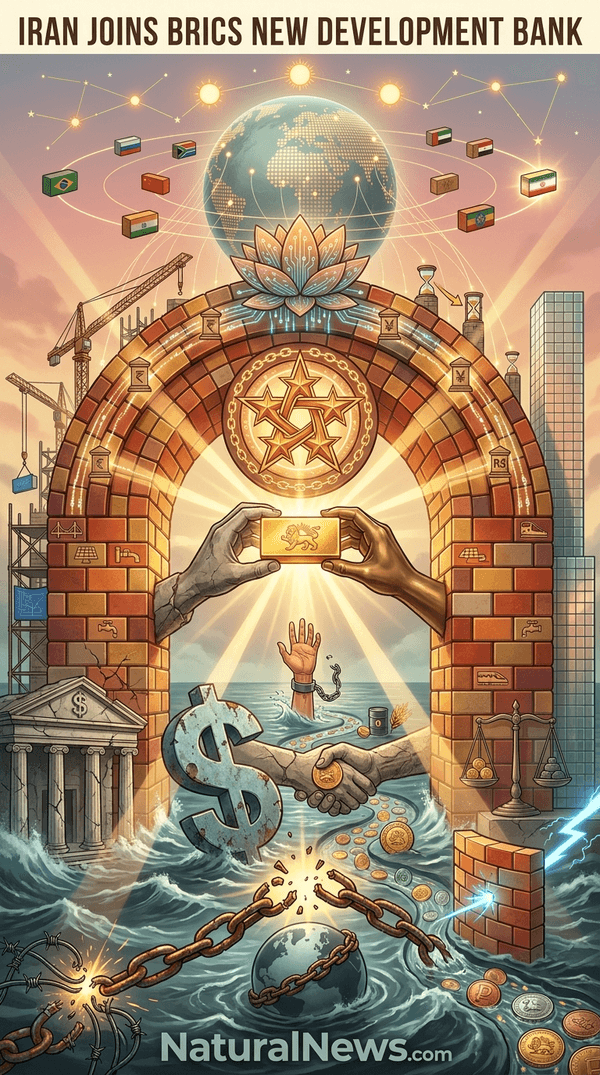
Central Bank of Iran Governor Abdolnasser Hemmati said on Aug. 12 that the Islamic Republic will soon join the BRICS New Development Bank. Hemmati spoke at the first meeting of BRICS finance ministers and central bank governors, which was hosted by India, according to remarks reported by Iranian state media. India has held the group’s rotating presidency since Jan. 1, 2026 [1].
His statement followed discussions among BRICS central bank officials about interlinking payment systems and digital currencies to lower the cost and increase the speed of cross-border transactions [2].
NDB Background and Iran’s Membership Bid
The New Development Bank was established in 2015 by Brazil, Russia, India, China and South Africa to finance infrastructure and sustainable development projects. The institution later widened membership to include the United Arab Emirates, Egypt and other emerging economies. Iran became a BRICS member in 2024, as part of an expansion that also added Egypt, Ethiopia and the UAE [3]. The bloc now accounts for roughly 46 percent of the global population, according to published estimates [3].
Iran has sought a shareholding in the NDB as part of a wider effort to operate outside the dollar-based financial system. According to Glenn Diesen and Alexander Lukin in “Russia in a Changing World,” the United States has increasingly used its financial predominance as a foreign policy tool, imposing sanctions against Iran, Venezuela, Russia and others [4]. Those policies, the authors wrote, stimulated efforts to weaken the infrastructure of U.S. financial hegemony [4].
Sanctions and Currency Cooperation
Hemmati said BRICS members are able to trade in their own currencies and that Iran is seeking bilateral and trilateral monetary cooperation with member states, according to the central bank governor’s remarks. The statement reflects a pattern already visible in Iranian trade policy. In 2022, Iran and Russia announced plans to drop the U.S. dollar in some bilateral trade settlements, and the head of Iran’s central bank at the time, Ali Saleh Abadi, said the two countries had switched to national currencies in types of settlements they mutually agreed upon [5].
Iran remains under sweeping Western sanctions. The country has pursued alternative economic networks, including arrangements that allow trade in national currencies rather than dollars, according to previous reporting [6].
De-Dollarization Steps Within BRICS
BRICS states have worked to reduce reliance on the dollar by promoting trade and financial transactions in national currencies. Emerging economies in the group are finding ways to cooperate and trade without the Western-dominated financial system, according to a December 2022 report [6]. The effort aims to reduce risks associated with exchange rate fluctuations and dollar-denominated debt [6].
Recent steps have focused on connecting existing payment systems rather than adopting a single BRICS-wide currency. In January, the Reserve Bank of India proposed linking BRICS digital currencies to facilitate cross-border payments [7]. RBI Governor Sanjay Malhotra said the group is discussing interlinking payment systems [2]. In November 2019, BRICS nations met to discuss a joint cryptocurrency, and Russian President Vladimir Putin said the U.S. dollar was likely to collapse soon, according to Catherine Austin Fitts in “The Solari Report: The State of Our Currencies” [8].
India’s Chairmanship and Bilateral Ties
India assumed the BRICS presidency on Jan. 1, 2026, and is scheduled to host the group’s summit later this year [1]. New Delhi has proposed linking BRICS digital currencies as a way to reduce reliance on the U.S. dollar [7]. At the finance ministers and central bank governors meeting, Indian officials said the group is discussing ways to reduce costs and increase speed in cross-border payments [2].
Iranian officials described the meeting as an opportunity to coordinate with states with which Iran conducts its widest monetary and banking exchanges, according to Hemmati’s remarks. The gathering also allowed Iranian and Indian officials to discuss cooperation in monetary, banking and digital economy fields, the governor said.
Outlook for Iran’s NDB Membership
Iran’s expected accession to the NDB follows years of advocacy by Tehran for greater use of national currencies in trade. Iran and Russia already switched to national currencies in some settlement types [5]. Iranian officials have also participated in broader BRICS discussions about a joint currency and digital settlement tools [8].
The expansion of BRICS to include Iran has increased the bloc’s share of global population to approximately 46 percent [3]. Final approval of Iran’s NDB membership has not been publicly confirmed by the bank.
References
- “India’s BRICS presidency pits the Global South against ‘America First’”. RT. January 20, 2026.
- “BRICS discusses interlinking payment systems and digital currencies”. RT. August 11, 2026.
- The New American. “BRICS “Unit” May Bring the World One Step Closer to Global Currency”. The New American. March 4, 2026.
- Glenn Diesen and Alexander Lukin. “Russia in a Changing World”.
- NaturalNews.com. “Iran Russia set to drop US dollar as currency in bilateral trade settlements”. NaturalNews.com. September 2, 2022.
- NaturalNews.com. “BRICS nations moving rapidly to circumvent the US dollar as the World Reserve Currency”. NaturalNews.com. December 2, 2022.
- “Indian central bank keen on linking BRICS digital currencies – Reuters”. RT. January 19, 2026.
- Catherine Austin Fitts. “Solari Report: The State of Our Currencies”.
Explainer Infographic
Submit a correction >>
Tagged Under:
big government, BRICS, Bubble, central bank, China, Collapse, currency crash, currency reset, dollar demise, economic riot, emerging economies, finance riot, Iran, market crash, money supply, progress, risk
This article may contain statements that reflect the opinion of the author
RECENT NEWS & ARTICLES